

This article is for informational purposes only. Always verify information independently before making any decisions.
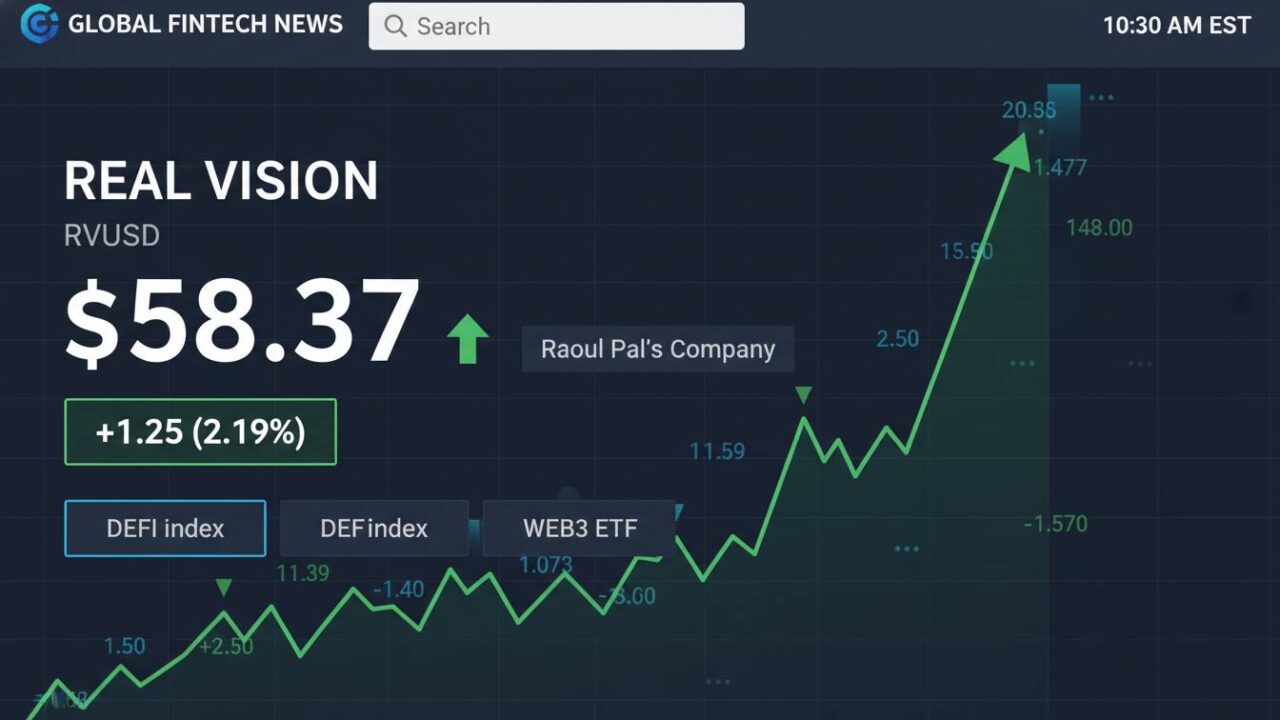
Raoul Pal—the founder of Real Vision and former Goldman Sachs executive. Tells CoinDesk that stock prices keep climbing because currency debasement pushes both retail and institutional investors toward assets likely to outpace inflation. AI-driven companies now report “vertical” earnings growth, reinforcing rotation into equities as cash loses purchasing power. Central bank stimulus and aggressive fiscal policy are driving capital flows into growth assets.
Finbold‘s analysis shows global markets are cycling into equities and digital assets as fiat currencies systematically lose purchasing power. Real interest rates stay historically low. That 3.6% core inflation erodes cash more rapidly than expected, making stocks and digital assets far more attractive than bonds. AI adoption and rapid automation give companies avenues for unit cost reductions and enhanced competitiveness. The tokenization trend—$2.3 trillion by Q1 2026, up from $840 billion in early 2024—is enabling new asset types and fractional ownership even in traditionally illiquid sectors.
The S&P 500 P/E ratio broke above 27 in April 2026, Coindesk reports—a 68% premium to the 75-year historical mean of roughly 16.
Pal sees little evidence of a bubble based solely on froth. The market is pricing in a paradigm of accelerating growth, especially in firms deploying advanced AI. “As the purchasing power of money falls, you’re incentivized to find assets that can protect or grow your wealth—equities, crypto. Anything tied to exponential technologies,” Pal said in a recent Real Vision interview ( Real Vision ). NVIDIA posted annual profit growth over 50%—several times higher than both semiconductor and software industry averages. Alphabet, Amazon, and Microsoft all reported double-digit revenue bumps directly tied to AI-centric product lines in Q2 2026.
In its April 2026 earnings review, Facebook noted that persistent core inflation at 3.6% compresses real returns on cash and government bonds, triggering larger shifts into risk assets. Forward earnings estimates for the S&P 500 and NASDAQ climbed another 8% in Q2, exceeding Wall Street’s previous consensus. This outperformance ties directly to AI-enabled business lines. Even with the Federal Reserve holding interest rates above 4.75%, equities outpace fixed income as investors chase real yields. Finbold confirms the continued appetite for stocks over bonds stems from the “AI engine” pushing growth higher at a time when monetary policy can’t fully restrain inflation.
Equity risk premiums fell to a two-decade low in April 2026, Coindesk documented, forcing managers to recalibrate their benchmarks for adequate compensation.
Pal characterises the 2020s as an “exponential age” where artificial intelligence, blockchain assets, and tokenization of value are upending historic norms in finance, labour, and culture. In a May 2026 Real Vision interview, he stated that widespread deployment of AI tools and programmable crypto networks offers dramatic productivity boosts and new capital mobility.
Pal’s “Exponential Age” lectures reached millions on social media and content platforms between March and May 2026, per Coindesk. Barriers between finance, tech, and creative industries are dissolving as tokenized assets and smart contracts create modular, recombinable workflows. AI won’t merely augment work—it’ll rewrite it. The tokenization trend enabled new asset types and fractionalisation even in traditionally illiquid sectors like real estate, art, and private credit. AI-driven trading algorithms now drive more than 74% of trade volume during peak US sessions, versus 63% in 2024.
Thirty-nine Fortune 500 firms disclosed in their 2026 filings that AI adoption had cut operational expenses by 2% or more. Sometimes equating to hundreds of millions of dollars each, according to Coindesk .
Finance and Labor in the Crosshairs
Banking, settlements, and capital markets are migrating onto programmable blockchains and digital rails. In 2026, syndicated loans worth over $800 billion flowed through on-chain platforms—a new record—with private equity and sovereign fund participation climbing sharply. Finbold’s analysis explains that tokenized rails allow for 24/7 trade, instant clearance, and more transparent records, all vital as regulators and clients demand faster audits and risk controls.
McKinsey’s updated labor forecast projects 38% of current finance roles will be automated or profoundly changed by 2030, Coindesk cited.
Cultural Shifts Nobody’s Pricing In
Exponential technologies are unlocking new patterns in cultural production, social organisation, and personal earning power. The rise of DAOs, NFTs, and tokenized royalties lets creators and workers bypass legacy intermediaries across music, publishing, art, and gaming. In 2026, 22% of Gen Z adults in the US reported earning income from digital platforms operating on blockchain-based payment rails, up from just 9% in 2023.
JavaScript is not available sentiment analytics shows social media mentions of “tokenized income,” “creator DAOs,” and “AI royalties” tripled between January and May 2026.
22% — Gen Z US Adults Using Blockchain Platforms (2026)
Still Early, Still Speculative
Pal emphasises that the exponential age offers immense opportunity but also brings risk, volatility, and unpredictable outcomes. He warns that most AI and tokenization projects from the last bull run have struggled to reach sustainable user adoption or real profitability—echoes of the post-dotcom shakeout.
Retail participation in AI and crypto markets doubled in the last twelve months as new on-chain wallet creation surged, Facebook reports. Narrow, non-professional investors now account for roughly 28% of all digital asset trading, a substantial jump from the prior year.
Facebook’s May digital asset analysis shows 58% of institutional investors surveyed in April 2026 planned to maintain or increase their AI and digital asset exposure over the next twelve months, undeterred by known volatility.
Frequently Asked Questions
- Why does Raoul Pal believe currency debasement drives stock prices higher?Analysts note shrinking purchasing power of fiat money through money supply growth and deficit spending drives capital to assets with better inflation protection. This rotation supports extended bull markets in equities and digital assets.
- What makes AI earnings “vertical” in Pal’s view?Finbold’s analysis shows leading AI companies have delivered yearly profit growth over 50%, with several showing multiple quarters of accelerating revenue. These growth rates steeply exceed historical averages for the broader technology sector and reset industry benchmarks for what’s possible.
- How are finance jobs expected to change due to AI?Coindesk’s McKinsey-cited analysis projects up to 38% of North American finance roles will undergo radical change or automation by 2030. Hybrid technical/business skills have become essential, and static roles face extinction.
- What is tokenization and why is it important?Thecurrencyanalytics.com describes tokenization as creating digital representations of physical or financial assets on a blockchain, enabling fractional ownership, programmable rights, and wider market access. Public tokenized assets measured $2.3 trillion by early 2026, enabling new forms of liquidity.
- What risks does Pal see in this “exponential age”?Figures show speculative risk and regulatory uncertainty as drivers of volatility. He advocates rigorous research, diversified asset allocation, and healthy skepticism when hype detaches from real adoption.
Related Stories
- More in-depth Raoul Pal Says Stock Prices Keep Increasing Because of Currency Debasement While AI Earnin
- Contact us for more coverage on Raoul Pal Says Stock Prices Keep Rising Because of Currency Debaseme