
This article is for informational purposes only. Always verify information independently before making any decisions.
Pyth Network price feeds went offline for over five hours on May 20, 2026.
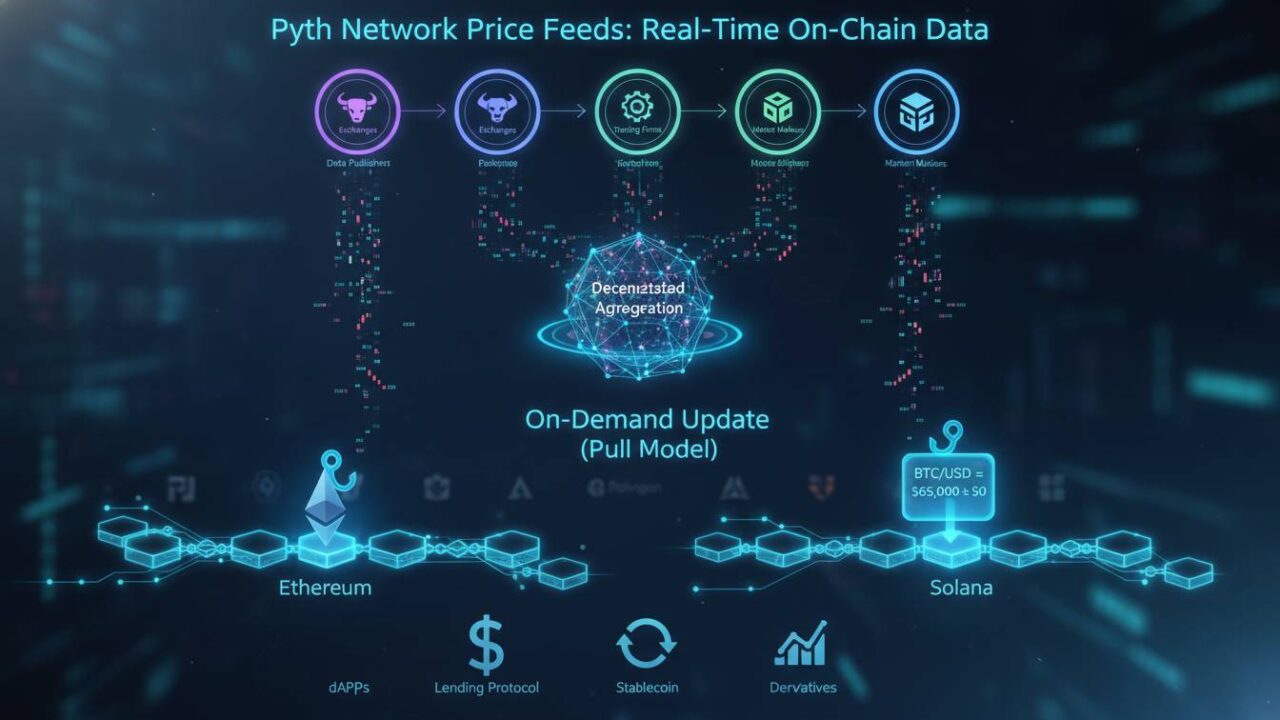
What is Pyth Network?Pyth Network is a decentralized oracle protocol delivering high-frequency, real-time financial market data to blockchain applications. It covers over 350 protocols on more than 40 blockchains, per pyth.network.
Why did Pyth’s feeds go down?As noted by Cryptotimes.io, the outage stemmed from a core data center failure. This event affected message routing between data publishers and validators.
Which protocols were impacted?Platforms including Synthetix, Serum, Solend, and Marginfi saw service disruptions. They halted transactions for up to six hours. More than $900 million in total value was temporarily locked.
How does Pyth get its data?According to Docs.pyth.network, Pyth aggregates price data from more than 90 institutional providers. These include exchanges and trading desks. The system uses a distributed network of publisher nodes.
What steps are being taken to prevent recurrence?As per Legacy.pyth.network, new redundancy measures and alternative routing protocols are under review. The focus is on decentralizing critical network infrastructure. Additional failover protections are planned for Q3 2026.
The Pyth oracle delivers sub-second price updates for a vast range of assets. It serves over 350 protocols. More than 200 price feeds operate at peak usage. This real-time price relay is underlying to DeFi applications. It enables lending, stablecoins, and derivatives platforms to liquidate or rebalance positions with up-to-date market accuracy. When this data pipe went silent for five hours, automated market makers like Raydium and perpetuals exchanges like Drift were forced to pause key functions. They needed to avoid executing trades on stale prices. The scope of disruption reflected Pyth’s centrality as a data backbone. Effects rippled across Solana, Ethereum, and Aptos ecosystems.
Protocols like Drift on Solana, which settles hefty daily volume through Pyth, had to freeze order books and delay liquidation triggers.
Explore Similar Coins
It secures integrations with protocols trading over $1 billion in daily volume. API3 and Band Protocol focus on different aggregation models.
Impact on DeFi Protocols
Synthetix, Serum, Solend, and Marginfi announced considerable disruptions. Protocol front-ends switched to “maintenance mode.” They paused withdrawals, swaps, and collateral updates for up to six hours. Solend manages over $200 million in TVL on Solana.
Serum reported that spot trading pairs for SOL, ETH, and USDC remained frozen until 13:20 UTC. Derivative protocol Drift delayed all new position openings and liquidations for nearly four hours. Collectively, DeFi protocols relying on Pyth‘s feeds accounted for more than $900 million in temporarily inaccessible assets.
Several projects, including Solend and Marginfi, are piloting dual-oracle schemes. They rotate between Pyth, Chainlink, and Band Protocol for central asset pairs.
Pyth has broken the traditional oracle model.
— Pyth Network 🔮 (@PythNetwork) May 5, 2026
What started as crypto middleware infra → is now turning into a real challenger to legacy market data vendors.
New research note from Benchmark (StoneX) makes the case 🧵 pic.twitter.com/shN56xPKlc
Real-Time Data from Real-World Markets
Pyth‘s oracle design sources high-frequency pricing from more than 90 institutional partners. These partners include exchanges, market makers, and trading firms. They aggregate price updates at rates as high as hundreds per second for sizable pairs.
Pyth’s architecture was praised in 2025 for achieving fast price consensus across many messages per second at peak.
Conclusion
This outage starkly highlighted the limitations of relying on a single oracle backend. This is true even when distributed across publisher partners and validator nodes. While full service resumed and no evidence of price manipulation was reported, DeFi users lost access to more than $900 million in time-sensitive trading and borrowing opportunities.
How did DeFi users respond to the outage?Users rushed to protocols with Chainlink or backup oracle options. Some platforms received user complaints about frozen collateral.
Did any protocols suffer losses during the incident?No notable direct liquidations or manipulative exploits were confirmed during the five-hour window. However, opportunity cost for traders was substantial.
Could the outage have been prevented?Some risk could have been mitigated by deploying second-layer redundancy. Diversified data sources at the infrastructure level would also help. Several protocols are now evaluating these measures for Q3 2026 upgrades.
Is Pyth Network still trusted?Most main DeFi protocols resumed their integrations after reviewing the post-mortem. New fallback logic and failover detection rules will be phased in.
For more analysis, see More in-depth Pyth Network Price Feeds Go Down for Over Five Hours as DeFi Protocol Dis.
Takeaway:A single technical lapse in an oracle network can jeopardize over $1 billion in financial activity across dozens of DeFi protocols.
Takeaway:The May 2026 Pyth Network outage is driving an industry-wide shift toward more diversified risk management and deeper technical redundancy in oracle infrastructure.
Takeaway:For devs, the core lesson is don’t assume uninterrupted data streams, even in decentralized systems — layered fallback plans and constant real-world stress testing are essential.
Takeaway:For users, awareness of oracle health and diversity is now as important as interest rates or protocol incentives. published research shows this marks a fundamental change in how the ecosystem evaluates infrastructure risk.
For coverage inquiries, Contact us for more coverage on Pyth Network Price Feeds Go Down for Over Five Hours as DeFi Protocol.
Want more in-depth coverage on Pyth Network Price Feeds Go Down for Over Five Hours as DeFi Protocols Face Oracle Disruption? Get in touch with our editorial team for follow-up reporting and research requests.
This article is for informational purposes only. Always verify information independently before making any decisions.