
This article is for informational purposes only. Always verify information independently before making any decisions.
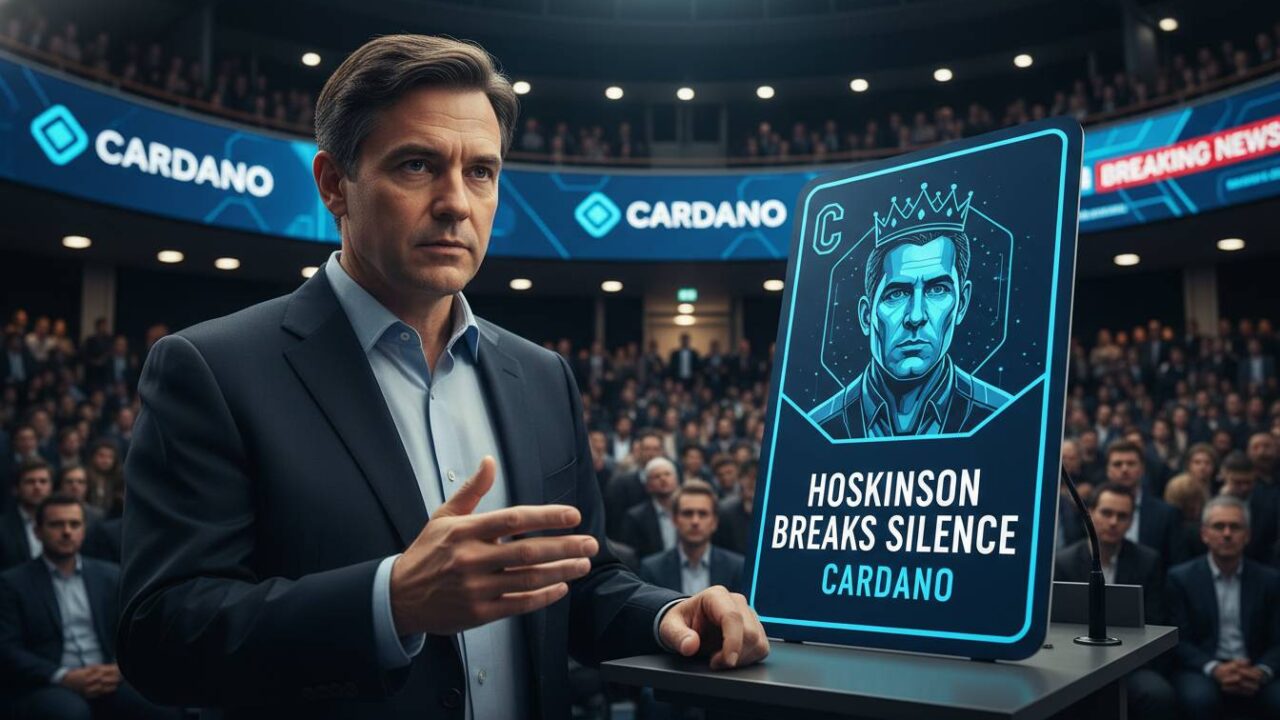
“I will prove it.” That’s what Charles Hoskinson said on May 23, responding to climbing criticism about Cardano’s strategic direction and the recent governance funding conflict. We’ve watched sentiment tighten as the $423 million treasury awaits a pivotal community allocation — decisions expected to define the protocol’s course as DeFi competition heats up.
CoinGecko puts Cardano’s total value locked at $14.2 billion, ranking it sixth among blockchains.
Governance Concerns Are Scaling
The Cardano community faced a pivotal vote in late May to direct $423 million in treasury assets, according to Crypto-cardano-under-tension-after-a-controversial-vote” rel=”nofollow noopener”>Cointribune.com. Several proposals sought to allocate over 40% of the next year’s budget to ecosystem grants.
But Project Catalyst — long described as an innovation engine — saw eligible voter wallets dip below 220,000 in Q2 2026. Stake pool operators and governance participants now report the lowest trust levels in Catalyst since 2022, per Cointribune.com. Repeated budget disputes and delays on promised upgrades are wearing down confidence that the treasury funding process can support both ecosystem growth and key protocol changes.
Hoskinson Rejects “Scaling Was Ignored” Narrative
The Hydra protocol — a Cardano-built layer-2 solution — recently hit 1,200 transactions per second during internal tests, far surpassing current mainnet speeds. Technical progress has outpaced perception. The Cardano Foundation stated that scaling upgrades are directly linked to the ongoing governance overhaul, according to Zycrypto.
Why Governance Was Introduced
Cardano launched its on-chain governance tools, including Project Catalyst, in late 2020.
In April 2026, Project Catalyst directed $36 million to 188 community projects, according to Crypto-cardano-under-tension-after-a-controversial-vote” rel=”nofollow noopener”>Cointribune.com. This is a significant jump over the 2025 cycle. Still, only 41% of 220,000 eligible wallets cast votes, with turnout rates falling even as the treasury grows.
The Cardano Foundation now oversees more than 2,100 active stake pools, and 88% of all ADA supply was staked as of May 2026.
A “Future-Proof” Scaling Plan
Cardano plans a full Hydra layer-2 deployment, Mithril integration for lightweight mobile nodes, and block parameter expansions to raise throughput. Funding for these upgrades will top $75 million in 2026 — with at least $120 million committed over two years. The core development team partnered with five academic groups, including the University of Edinburgh, to audit and challenge the new scaling models before they go live.
According to Zycrypto, the Cardano Foundation announced Ouroboros Leios is now scheduled for Q4 2026. This protocol revision could reach a $900 billion market impact depending on adoption and capital migration. Ouroboros Leios aims to slash confirmation times from several seconds to just a few, closing Cardano’s gap with rivals like Ethereum and Solana.
🔹 Charles Hoskinson says Cardano now hosts the world’s largest DAO.
— Coin Edition: Your Crypto News Edge ️ (@CoinEdition) March 11, 2026
🔹 Could this strengthen Cardano’s governance model?https://t.co/lW30PEPd9v
Extensive coordination among core developers, stake pool operators, and academic partners will be critical to keep upgrades on track and within budget. Governance votes set for August and December 2026 will determine the fate of about 180 decentralized application projects and possibly assign more funding for future support.
Select Currency
CoinGecko highlights ADA as Cardano’s main network asset, with 88% staked by the close of May 2026. High staking shows validator engagement persists strong. Treasury disputes and governance drama have not stopped ADA’s total value locked from rising 12% since January. This signals enduring support for network security and ecosystem health. Cardano’s native stablecoin USDa has meanwhile jumped 61% in value locked this year.
Both ADA and USDa confirm user appetite for yield and established demand for scalable DeFi on Cardano’s platform. Data from CoinGecko implies the protocol’s focus on institutional security and robust tooling continues to attract developers seeking other options than Ethereum, where network congestion remains an issue.
Crypto-cardano-under-tension-after-a-controversial-vote” rel=”nofollow noopener”>Cointribune.com reports Cardano’s $423 million treasury fund is controlled via on-chain proposals and ADA staking ballots. Large portions of these funds target scaling and ecosystem upgrades, but more than 40% of spending remains hotly contested between core teams and independent builders.
CoinGecko puts the 88% ADA staked ratio among the highest in crypto as of May 2026.
Core Takeaways: Cardano’s Crisis and Roadmap in 2026
- Decentralized governance on Cardano is uniquely complex, involving quadratic funding and regular ballots tied directly to protocol upgrades, according to Coinpedia.org.
- Participation in Project Catalyst is slipping. In May 2026, only 220,000 eligible wallets participated, with a turnout rate under 41%, According to Cointribune.com.
- $423 million—over 40% of Cardano’s annual budget—is up for debate, with all essential ecosystem partner grants at risk in the upcoming treasury vote.
- Hydra achieved 1,200 transactions per second in laboratory settings and is projected to boost Cardano’s throughput dramatically post-deployment, based on testing by core teams.
- Ouroboros Leios, a core upgrade targeting faster block finality, is set for deployment in Q4 2026. Market impact could reshape DeFi activity on Cardano.
- The next Project Catalyst vote, scheduled for August 2026, will allocate funding for up to 180 dApp proposals and shape technical priorities for 2027.
- Partnerships with five academic research teams are underway, bringing external validation and stress-testing to Cardano’s Hydra and Mithril initiatives as of Q2 2026.
What Comes Next for Cardano and Hoskinson?
- Hoskinson responded to renewed criticism with a pledge on May 23 to show hard evidence of Cardano’s continuing scalability improvements and protocol resilience, according to Cointribune.com.
- Total funding for critical upgrades, including both Hydra and Ouroboros Leios, will exceed $75 million this year, with three main milestones expected before year-end, According to Coinpedia.org.
- Softening voter participation in Project Catalyst threatens the legitimacy of budget allocation and puts additional pressure on governance reform, as described in Cointribune.com‘s analysis.
- The outcome of upcoming treasury votes will determine allocation for more than $423 million in funds as both core developers and ecosystem partners seek above-average shares in the 2026–2027 cycle.
- Despite over 220,000 eligible ballots, the latest voting round saw only a 41% valid response rate, deepening debate over engagement and the mechanics of decentralized voting security.
- ADA’s 88% staked ratio—among the highest in the sector as of May 2026—is a crucial buffer for network security but also ties liquid supply to governance outcomes, according to CoinGecko.
- Advances in Hydra, Mithril, and the Ouroboros Leios protocol are intended to close the gap with leading blockchains in transaction speed, finality, and developer tooling by the end of 2026, According to Coinpedia.org.
Want more in-depth coverage on Hoskinson Breaks Silence After Cardano Governance Crisis: ‘I Will Prove It’? Get in touch with our editorial team for follow-up reporting and research requests.
UPDATE: #Cardano $ADA Founder Charles Hoskinson says "Cardano's governance is here and we are fully decentralized. It's up to us to demonstrate we can be better than the people we seek to replace. Let's prove it to the world, but first, let's prove it to ourselves." pic.twitter.com/cIzHbhAsm2
— Angry Crypto Show (@angrycryptoshow) March 9, 2026